Why consumer companies -especially – D2C brands – must productize their GTMs – Part 1
In the early days of a consumer brand, particularly a D2C one, growth often comes from hustle. A strong founder instinct, a viral campaign, a marketplace boost, or a performance marketing spike can create momentum fast. The brand moves quickly, the team is scrappy, and the wins feel earned.
But as the business scales, that same instinct-led approach becomes a liability. What got you here won’t get you there, and in consumer businesses, nowhere is that truer than in how you take products to market.
This is where productizing your GTM stops being a “nice to have” and becomes a strategic necessity.
What Does “Productizing GTM” Actually Mean?
Productizing GTM means treating your go-to-market motion not as a collection of tactics, but as a repeatable, modular, and scalable system, much like a product itself.
The shift looks like this:
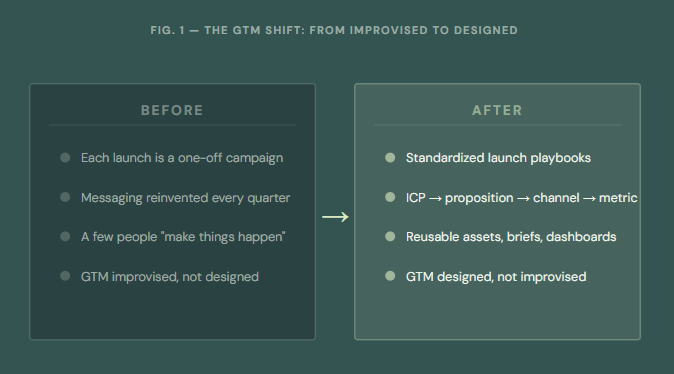
The goal isn’t to kill creativity or reduce everything to a template. It’s to ensure that when your team shows up to launch a new SKU, a new category, or a new channel—they’re not starting from zero every single time.
In short: GTM becomes designed, not improvised. And that distinction compounds in ways most leadership teams underestimate.
Why This Hits D2C Brands Harder Than Most
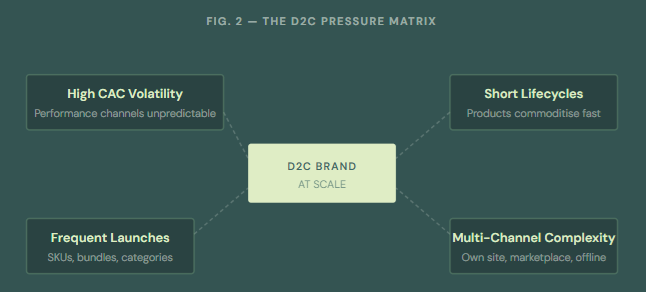
D2C brands face a uniquely brutal combination of pressures that make GTM discipline non-negotiable at scale. High CAC volatility, short product life cycles, frequent launches across SKUs and categories, and the complexity of managing own-site, marketplaces, social commerce, and offline simultaneously—all at once.
Without a productized GTM, teams end up in permanent firefighting mode: launching fast, learning slowly, and scaling inconsistently. Every launch feels like a fire drill. And the compounding cost of that—in time, money, and organizational exhaustion—is enormous.
Four Reasons Productized GTM Changes the Game
1. Consistency Beats Creativity at Scale
Early on, creativity drives growth. At scale, consistency compounds it. There’s a reason the brands that last aren’t necessarily the most creative ones—they’re the ones whose brand promise means the same thing whether you encounter it on a performance ad, a product detail page, a CRM email, or a retailer shelf.
A productized GTM ensures that new team members can execute launches without founder hand-holding, and that agencies plug into a system instead of guessing the brand each time. Creativity still matters—but it now operates within a clear frame. That frame is what makes it scalable.
2. Faster, Cheaper, Smarter Launches
Most D2C brands dramatically underestimate how expensive “learning every time” really is. Not just in direct costs, but in the organizational tax of constant reinvention—the brief that gets written four different ways, the shoot that gets redone, the campaign that launches two weeks late because no one agreed on the hook.
When GTM is productized, the question shifts from “How do we launch this?” to “Which version of our GTM system does this product need?” That shift alone can unlock weeks of speed and meaningful margin gains—before you’ve even changed your media mix.
3. Clear Ownership Across Functions
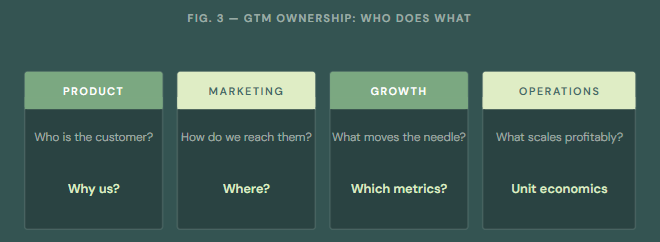
One of the biggest hidden costs in consumer companies is GTM ambiguity. Who owns the proposition? Who owns the pricing logic? Who decides the channel mix? Who defines success? In the absence of a productized GTM, these questions get answered differently every time—or not at all.
Productized GTM forces this clarity before launch, not after. The result is less friction, less rework, and dramatically higher execution velocity across functions.
4. Better Signal, Less Noise
D2C brands drown in data but starve for insight. Every platform produces dashboards, every campaign generates numbers—but without a common baseline to compare against, the data tells you very little.
When GTM is productized, every launch has predefined success metrics, funnel benchmarks are known upfront, and post-launch reviews compare outcomes to a standard—not to gut feel. Leadership teams can kill faster, double down with confidence, and allocate capital more intelligently. The difference between a team that uses data and a team that acts on it is usually a question of system, not sophistication.
Part 2 of this blog is coming soon. It will cover what a productized GTM might look like.